
Today, I tried to change an international flight using the airline carrier’s mobile app, but the app didn’t allow me to change my flight. I tried the website, hoping for a full-featured experience, but that didn’t work either.
A Customer Support Story
I contacted customer support and, using text messaging, chatted with the airline company. The first thing the customer support representative asked me to do was try to change my ticket using the mobile app or the website.
After context setting, I eventually shared my confirmation number and was asked to verify my account.
Usually, customers are often asked to verify their accounts by providing a PIN or a one-time password (OTP). In this case, they asked for flight details. Since I was chatting on my phone, the idea of copying flight details into a chat was too annoying. So I sent a screenshot, which worked.
The next step was payment. For some reason, I couldn’t use my payment card. I tried, three times, but my payments failed. I had to use a different card to complete the payment. As someone with a decade of experience in the payments industry, the failed payment was very strange.
After 30 mins of customer support, the payment was successful and my flight was finally updated. The irony of a payments professional unable to make a payment was not lost on me. I shared the irony with the customer support rep.
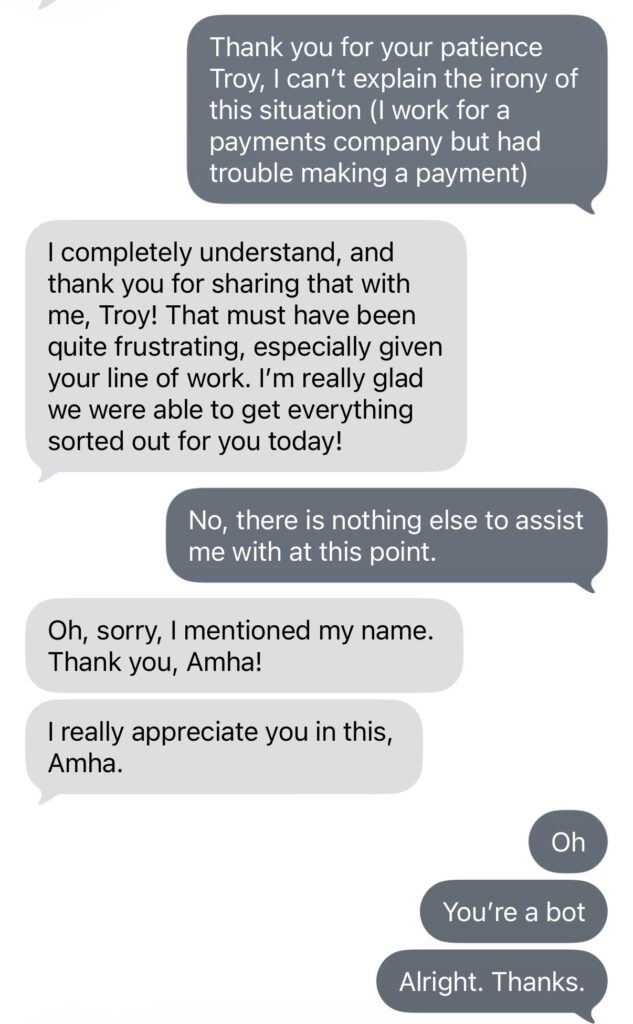
Turns out Troy was an agent. How did I figure it out? The response gave it away:
AI & Behavior Change
When I realized Troy was a chatbot, my behavior surprisingly changed. I no longer felt the need to invest in the exchange because it wasn’t a conversation. A good conversation leads to connection or understanding, while exchanges are task-oriented. I became goal-oriented and, based on the environmental impact of saying ‘thank you’ to LLMs, I stopped being friendly.
How common was my change in tone? Based on new research, it seems my reaction is common. My shift in tone is rooted in the following insight: 70% feel the overall customer service experience would be worse if humans were removed in favor of AI. .
As AI use cases continue to scale, AI Customer Support research has focused on likeliness of customers to use AI customer support and benefits to businesses.
My question is more nuanced: how do AI-powered customer support agents that simulate human actors impact customer mental models, perceived brand trust, and engagement? Companies that define new social contracts, which balance AI with customer expectations, will create more value for all parties.